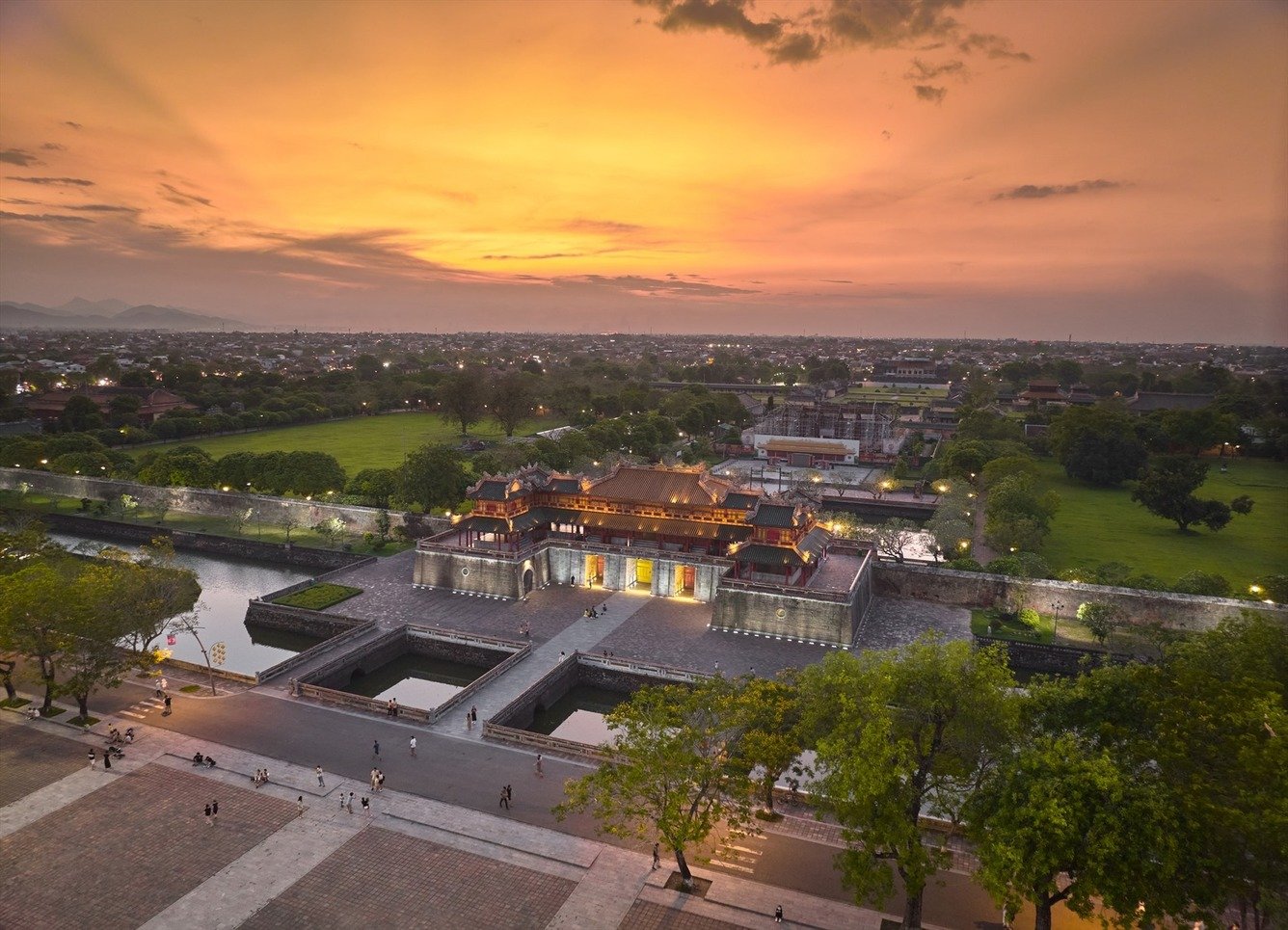
The Nine Dynastic Urns (Cuu Dinh) are nine bronze urns ordered by Emperor Minh Mang. Their casting began in December 1835 and was completed in 1837. After they were finished, the urns were placed in front of The To Mieu, behind Hien Lam Cac, inside the Imperial City of Hue. They have remained in the same place until today.
After nearly 200 years and many devastating wars, the Nine Dynastic Urns are still remarkably well preserved. They are the original and unique artifacts and have never been restored or repaired since they were created. This makes them extremely valuable and irreplaceable historical treasures.
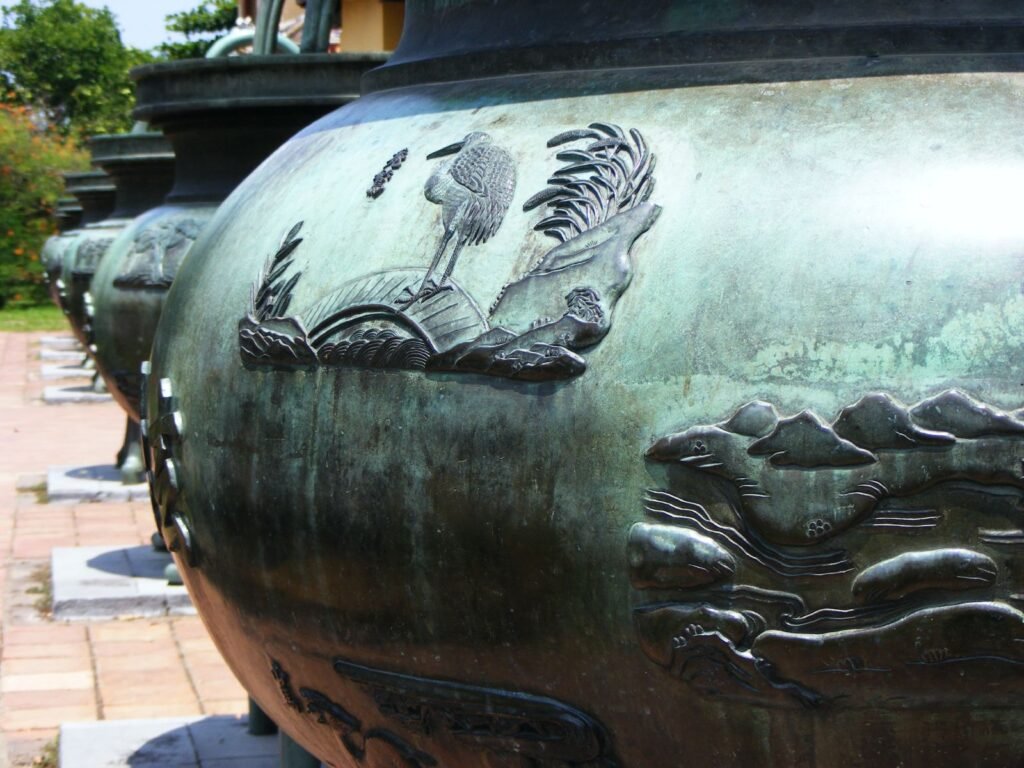
The Nine Dynastic Urns were not simply created to represent the power of the Nguyen Dynasty. They also present a picture of Vietnam in the early 19th century. Across the nine urns are 162 finely carved raised-relief motifs, showing mountains, rivers, seas, plants, animals, weapons, boats, and many other features of the country.
The number nine was especially important to Emperor Minh Mang. In East Asian culture, nine is considered a sacred number, symbolizing Heaven, completeness, authority, and power. Therefore, the Emperor used the number nine as the main idea behind the entire collection. The motifs were carefully selected and arranged into groups of nine, including nine great mountains, nine major rivers, nine sea gates, nine sacred animals, nine birds, nine types of crops, nine flowers, nine medicinal plants, nine weapons, and many others.
The images on the urns show the diversity of Vietnam from north to south. For example, the Red River is carved on Tuyen Dinh, the Mekong River on Huyen Dinh, and the Perfume River on Nhan Dinh. Cao Dinh features a tiger from the mountains, while Nhan Dinh shows a whale from the sea.
Some of the images are also connected with stories from the difficult early years of the Nguyen Dynasty. One example is the lon bon tree, carved on Nhan Dinh. Lon bon fruit is very sweet and grows abundantly in the forests of Quang Nam. According to tradition, in the late 18th century, when Nguyen Vuong Nguyen Phuc Anh was being pursued by the Tay Son forces, he hid in the forests near the Vu Gia River and survived by eating lon bon fruit.
After Nguyen Vuong became Emperor Gia Long, he named the tree phung quan moc, meaning “the tree that met the emperor.” Perhaps for this reason, Emperor Minh Mang ordered its image to be carved on Nhan Dinh.
A crocodile was also carved on Chuong Dinh. According to tradition, Nguyen Phuc Anh once crossed a river safely because crocodiles prevented his enemies from reaching him. Another story tells that when his boat traveled toward Tho Chu Island, a sacred serpent helped keep the boat balanced and prevented it from overturning.
The Names of the Nine Urns
The nine urns are arranged around The To Mieu, with Cao Dinh in the center.
Their names were based on the posthumous titles of the Nguyen emperors. Cao Dinh represents Emperor Gia Long, Nhan Dinh represents Emperor Minh Mang, Chuong Dinh represents Emperor Thieu Tri, and Anh Dinh represents Emperor Tu Duc. Nghi Dinh, Thuan Dinh, and Tuyen Dinh are associated with Emperors Kien Phuc, Dong Khanh, and Khai Dinh.
Each urn also stands opposite the altar of a corresponding emperor in The To Mieu.
However, Du Dinh and Huyen Dinh did not become the posthumous titles of any Nguyen emperor. This was related to the complicated history of the dynasty. Emperors Duc Duc and Hiep Hoa were deposed by Ton That Thuyet. Emperor Ham Nghi, with the support of Ton That Thuyet, issued the Can Vuong Edict, calling on scholars and patriotic officials to rise up and help the Emperor save the country and resist the French.
Emperors Thanh Thai and Duy Tan were later deposed and exiled by the French, while Emperor Bao Dai eventually abdicated. Because these emperors did not receive corresponding posthumous titles, the names Du Dinh and Huyen Dinh were not used as the posthumous titles of any Nguyen emperor.
Placed in front of The To Mieu, the Nine Dynastic Urns symbolized the authority, achievements, and lasting legacy of the Nguyen Dynasty.
An Illustrated Record of Vietnam’s Nature
The Nine Dynastic Urns can also be considered an early illustrated record of Vietnam’s biodiversity.
Among the 162 raised-relief motifs, 90 depict plants and animals. The images include rice, betel, jackfruit, onion, turmeric, perilla, peanuts, cinnamon, pine, ironwood, flowers, fruit trees, medicinal plants, birds, fish, insects, large animals, and sacred creatures.
The artisans carefully carved many details, making the plants and animals easy to recognize. For this reason, the Nine Dynastic Urns can be seen as an ancient illustrated book of Vietnam’s biodiversity, or even compared with a historical Red Data Book showing the country’s valuable species.
The images are not only beautiful decorations. They also reflect the rich natural environment of Vietnam and the close relationship between Vietnamese people and nature.
The Nine Dynastic Urns and Vietnam’s Sea and Island Sovereignty
One of the important meanings of the Nine Dynastic Urns is their connection with Vietnam’s sea and island sovereignty.
Three of the most important urns contain images representing the sea:
- Cao Dinh – the Eastern Sea
- Nhan Dinh – the Southern Sea
- Chuong Dinh – the Western Sea
These are the three largest and most important urns in the collection.
Together with other ancient Han-Nom historical documents, the images of the seas and islands carved on the Nine Dynastic Urns are valuable historical sources related to Vietnam’s sovereignty over the Hoang Sa and Truong Sa archipelagos. They also show that the Nguyen emperors paid attention to protecting and exercising sovereignty over Vietnam’s seas and islands.
The Nine Dynastic Urns are also unique from an international perspective. There is no similar set of nine urns in the imperial palaces of China, Japan, or Korea. Even among earlier Vietnamese dynasties, no comparable set has survived.
A Masterpiece of Vietnamese Bronze Casting
The Nine Dynastic Urns demonstrate the highly developed bronze-casting skills of Vietnamese artisans in the 19th century.
According to Kham dinh Dai Nam hoi dien su le, the urns were made using traditional handmade casting techniques. The artisans carefully selected suitable clay to create the molds and had to make the molds with very precise proportions.
Each mold was unique. After an urn was successfully cast, the mold was destroyed to prevent copying. According to historical records of the Nguyen Dynasty, the urns were cast one by one, and the casting process took nearly seven months.
The raised-relief decorations required great patience, skill, and concentration. The artisans of Hue created highly detailed works that demonstrate the outstanding level of Vietnamese bronze casting at that time.
The Nine Dynastic Urns are therefore not only works of art but also valuable historical documents. Their shapes, inscriptions, and decorative motifs were carefully designed, and the motifs do not simply repeat themselves elsewhere.
Unlike objects that were produced in large numbers, the Nine Dynastic Urns were created as a unique set. They can be considered a limited and irreplaceable collection of imperial heritage.
Since their completion in 1837, nearly 200 years have passed. Despite many historical changes, there is no record in the official history of the Nguyen Dynasty or other sources of the urns being restored or significantly altered.
This makes them important original historical sources, preserving much of their original information and appearance until today.
The Need to Protect the Nine Dynastic Urns
Although the Nine Dynastic Urns have survived for nearly two centuries, they now face natural deterioration.
Because they are made of bronze and have been exposed to rain and sunlight for more than 200 years, their surfaces are affected by electrochemical corrosion. Dirt and other deposits have also accumulated because of birds, insects, people, and environmental conditions.
Water can collect inside the urns, allowing moss to grow. Some parts of the bronze surfaces have also been damaged, including marks believed to have been caused by bullets, reducing the thickness of the bronze.
Because of these natural and human-related risks, proper conservation measures are important to protect the Nine Dynastic Urns for future generations.
Because of their great historical and cultural value, the Nine Dynastic Urns were recognized as National Treasures of Vietnam in 2012.
Today, the Hue Monuments Conservation Centre is completing a dossier to submit to UNESCO, seeking recognition of the Nine Dynastic Urns of Hue as World Documentary Heritage.
Hue – A City of World Heritage
Hue is already home to several important UNESCO-recognized heritages. The Complex of Hue Monuments was recognized as World Cultural Heritage in 1993. Nha Nhac – Vietnamese Court Music was recognized as a Representative of the Intangible Cultural Heritage of Humanity in 2003.
Hue also has three documentary heritages under the Memory of the World Programme:
- Woodblocks of the Nguyen Dynasty – 2009
- Imperial Archives of the Nguyen Dynasty – 2014
- Poetry and Literary Texts on Hue Royal Architectural Works – 2016
In the future, Hue is expected to become a destination with six World Heritage designations. This is a great source of pride for Hue and an important opportunity for researchers to study the city’s history and cultural heritage.
The Nine Dynastic Urns are therefore much more than nine old bronze vessels. They are a unique historical record of Vietnam, preserving images of its mountains, rivers, seas, plants, animals, culture, and imperial history.
Today, standing quietly in front of The To Mieu, the Nine Dynastic Urns continue to tell the story of Vietnam through history, art, craftsmanship, and the worldview of people nearly 200 years ago.
Discover More of Hue
Want to discover more about Hue? Join Hue Free Walking Tours and explore the history, culture, local food, and hidden stories of Hue with our friendly local guides. Check out our tours and experience Hue from a local perspective!